
Introducing CTR - The Coordination Asset for the Bitcoin Economy


Today, we introduce CTR, the coordination asset handing control of the Bitcoin economy back to its users.
Bitcoin gave us something no financial system ever had: a trustless peer-to-peer electronic cash system. As Bitcoin established itself as the asset for censorship-resistant finance, the need for BTC in various financial use cases has become more prominent.
Many attempts have been made to build an ecosystem for Bitcoin, but they were either forced to sacrifice programmability or rely on heavy trust assumptions that hindered adoption. As a result, BTC moved to other blockchains and benefitted their intermediaries, pulling liquidity and activity away from Bitcoin itself.
The need for programmability was real, but the compromise didn't have to be. Over the past two years, Citrea built the infrastructure that enables the first trust-minimized BTC on a fully programmable Bitcoin layer. On top of this infrastructure, we built an end-to-end Bitcoin economy that relies on the Bitcoin Network as its sole source of truth.
Today, with CTR, we're handing control of this economy to the people who use it.
What We Actually Built: The Bitcoin Economy
Over the past two years, Citrea has shipped a series of firsts for Bitcoin: the first ZK Rollup secured entirely by the Bitcoin Network, and Clementine, the first trust-minimized BTC bridge built on BitVM.
On this foundation, we launched ctUSD, a native stablecoin for Bitcoin issued by MoonPay and designed to align with the forthcoming GENIUS Act guidelines. This launch has provided the Bitcoin ecosystem a native liquidity standard and banking rails between on-chain Bitcoin collateral and off-chain fiat systems.
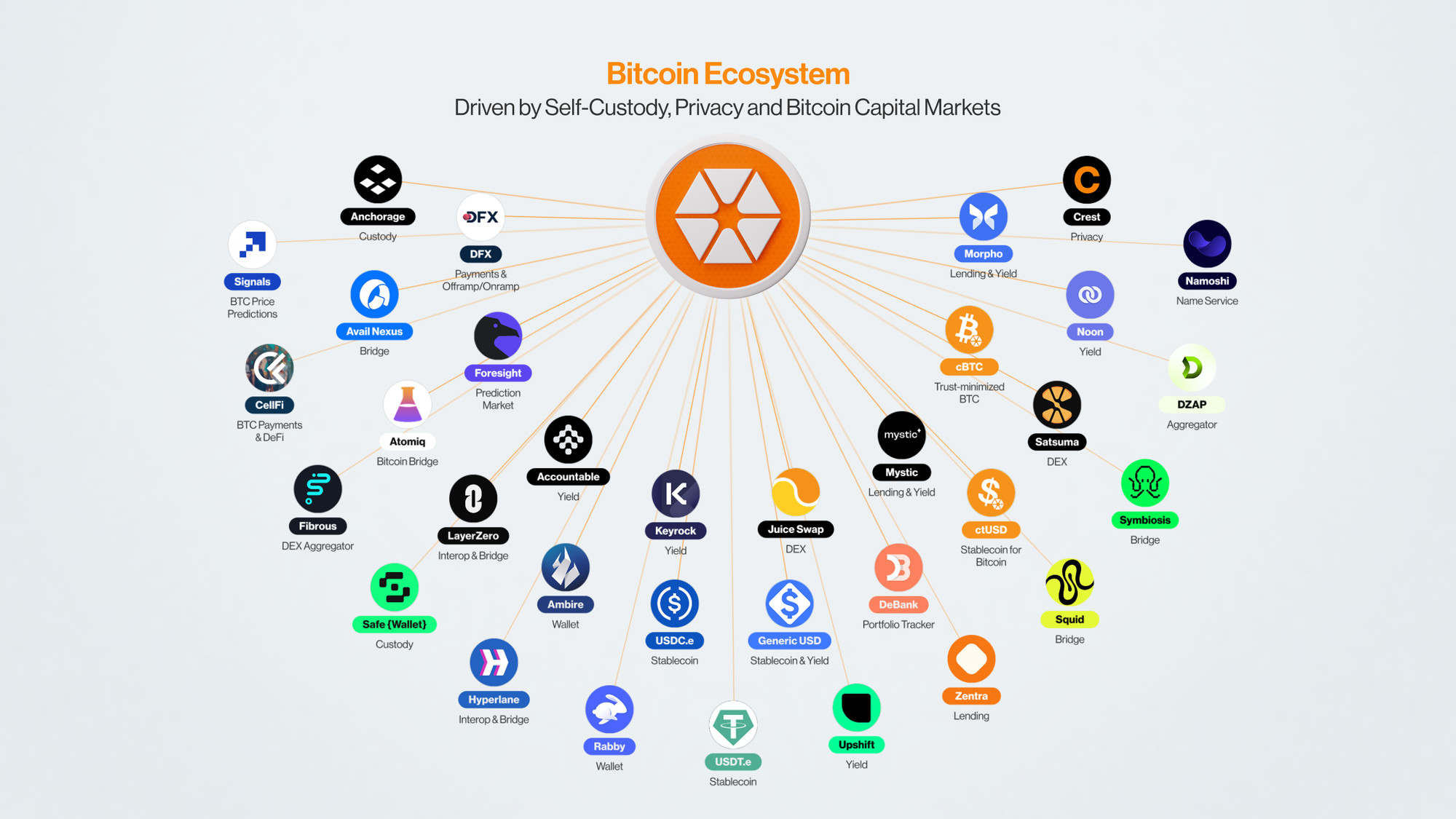
We've worked with founders one-on-one to build a unique ecosystem for Bitcoin Capital Markets. We've brought blue-chip applications and infrastructure to Bitcoin for the first time. Citrea’s ecosystem has grown into a diverse Bitcoin economy driven by BTC payments, lending, trading, prediction markets, and BTC yield.
We are now at the stage where users must direct where that value flows. That is what CTR enables.
The Problem: An Ownership Gap in Bitcoin's Economy
As protocols evolve and their liquidity grows, the distribution of incentives becomes critical. Most foundations today make top-down decisions about where capital goes. As a result, incentives flow to short-term capital that farms rewards and exits. Active users and builders of the network watch their influence shrink as capital decisions are made top-down, beyond their control.
This triggers a destructive loop. Committed participants disengage as their stake in the ecosystem is decoupled from its capital flow. Meanwhile, rent-seeking capital is over-rewarded, harvests value, and leaves.
We call this the Ownership Gap: the disconnect between who creates long-term value in an ecosystem and who captures it.
CTR: Own the Bitcoin Economy
Citrea’s ecosystem and capital have matured to a stage that requires a transition from top-down decisions to user-led economic coordination.
As part of Citrea’s user-owned growth stage, we're introducing CTR and its staked form, xCTR - the coordination asset for the Bitcoin economy.
xCTR is designed to close the Ownership Gap by giving aligned users and applications direct control over how ecosystem capital is allocated. These holders curate the flow of value in their own interests; building toward an efficient, user-owned Bitcoin economy that prioritizes self-custody and capital markets.
The Coordination Asset Model: How CTR Works
CTR embodies the belief that the Bitcoin economy should rely on the strategic interests and active curation of its own users. This is accomplished through a modified vote-escrow staking model.
Users stake CTR to receive xCTR, a non-transferable token that grants voting power over the Citrea Governance Treasury and the Citrea Network. Holding xCTR anchors users into the protocol's long-term success: users don't just hold a token, they hold a stake in how the Bitcoin economy is governed.
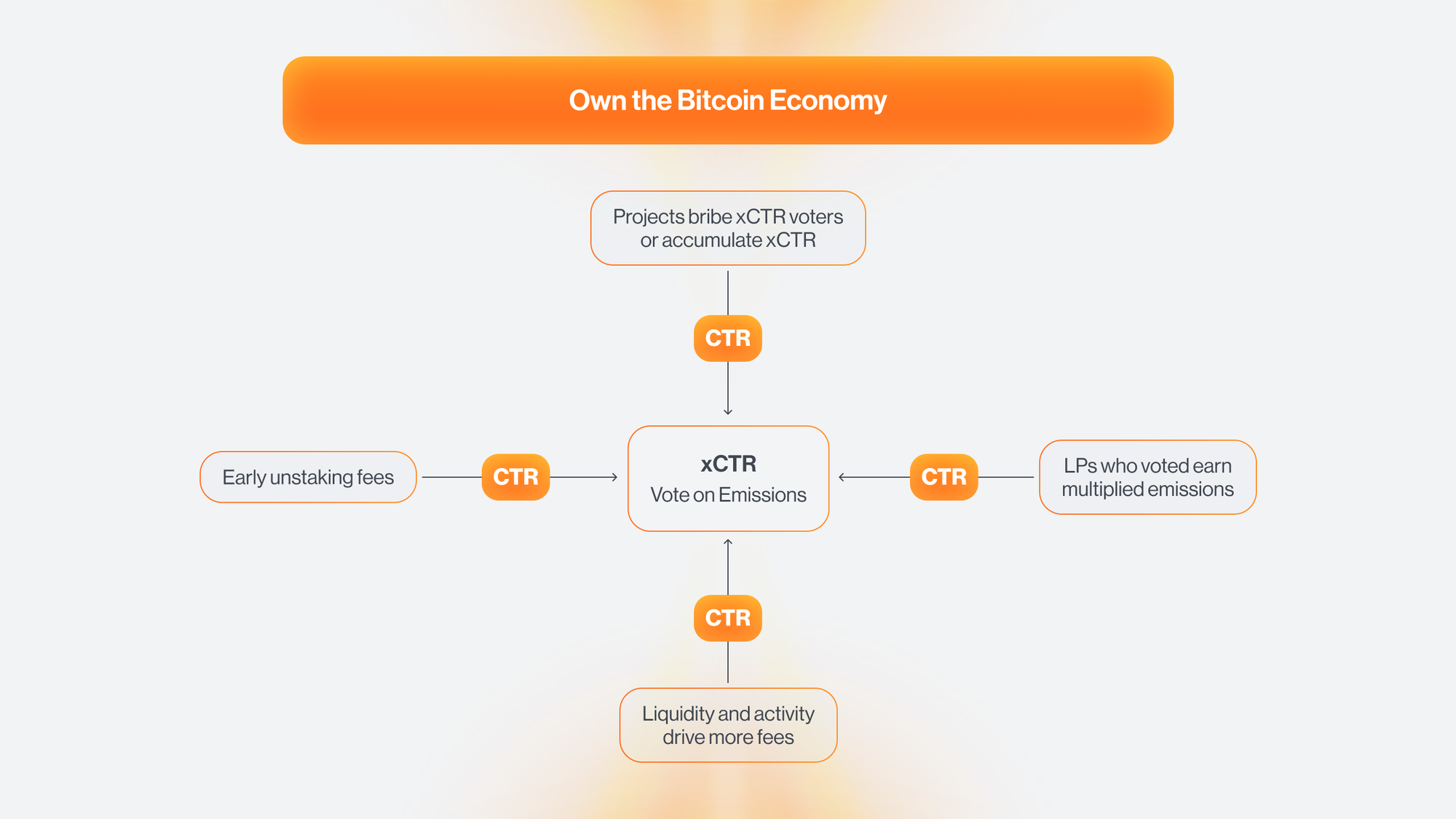
Staking Mechanics
Unlike most vote-escrow models that lock liquidity for a fixed period, xCTR takes a different approach.
xCTR is a modified ERC-4626 vault receipt token which is non-transferable. Stakers receive xCTR based on their share of the contract (starting at 1:1 and adjusting as staking rewards and other sources flow in). Unstaking happens over a 90-day window with a variable penalty:
- Instant exit: 50% flat penalty fee.
- Exit between day 15 and day 90: Decaying penalty from 50% down to 0%.
Penalties paid by early exiters are distributed pro-rata to remaining stakers, directly rewarding those who stay aligned. Both the penalty rates and the length of the unstaking period are governed by xCTR holders and can be changed by governance as the protocol matures.
The Dual Treasury: Foundation and Governance
Efficient ecosystem growth requires users to control where capital flows as incentives. But we recognize that not all functions are suited for a DAO. Strategic R&D, enterprise partnerships, and high-stakes operations require a level of confidentiality and execution speed that collective governance cannot always provide.
This is a well-known problem. Pure foundation-led models leak value to extractive capital. Pure DAO models move too slowly on strategic decisions. Citrea solves this with a Dual Treasury Model that cleanly separates responsibilities:
- Citrea Governance Treasury (controlled by xCTR holders) handles liquidity incentives, council selection and payments, and infrastructure provider selection and payments.
- Citrea Foundation Treasury handles R&D, ecosystem grants, operations, and strategic initiatives. The Foundation cannot use its treasury for liquidity emissions (excluding initial liquidity incentives for CTR and previous deployments). If the Foundation wants to run such a program, it must request it from Governance with clear goals and KPIs.
At launch, the Citrea Foundation serves as the infrastructure provider, running the sequencer and prover, and coordinating the security council.
Gauge System: The Compounding Flywheel
The gauge system is an automated mechanism for distributing liquidity emissions from the Governance Treasury. It’s a self-optimizing mechanism that lets the market dictate emissions. If a pool attracts more liquidity, its incentives shift naturally; if not, the market self-corrects to find a more ideal equilibrium. Instead of voting on incentives one by one, xCTR holders direct emissions through a dedicated on-chain voting system.
Unlike the majority of gauge systems, Citrea's can be implemented flexibly, not only to reward specific applications, but to incentivize different user behaviors, such as users of neobanks on Citrea, with the help of designated off-chain providers such as the Foundation and other third parties. The set of eligible applications can expand further and dynamically through a vetting committee that Governance may choose to establish.
Exact structure, parameters, and budget for the gauge system are subject to governance discussion and activation.
The gauge system creates a network-level incentive loop that puts active xCTR voters at the center of economic coordination:
- Holding CTR alone doesn't grant voting rights. For voting, users must stake.
- Staked CTR that isn't used for gauge voting only earns unstaking penalty fees and emissions.
- Active voters receive multiplied liquidity emissions on the pools they vote for.
This mechanism prioritizes aligned users of the network over extractive capital for emissions, and encourages liquidity providers to join the coordination economy by buying and staking CTR.
As the ecosystem matures, xCTR holders can receive not only multiplied emissions through their votes, but also bribes from applications competing for liquidity or they can use automated bribing layers that provide a liquid wrapper around xCTR.
By voting emissions toward specific pools, xCTR voters trigger a flywheel: value created in the Bitcoin economy flows back to the participants whose actions and curation made it possible.
CTR Distribution and Supply
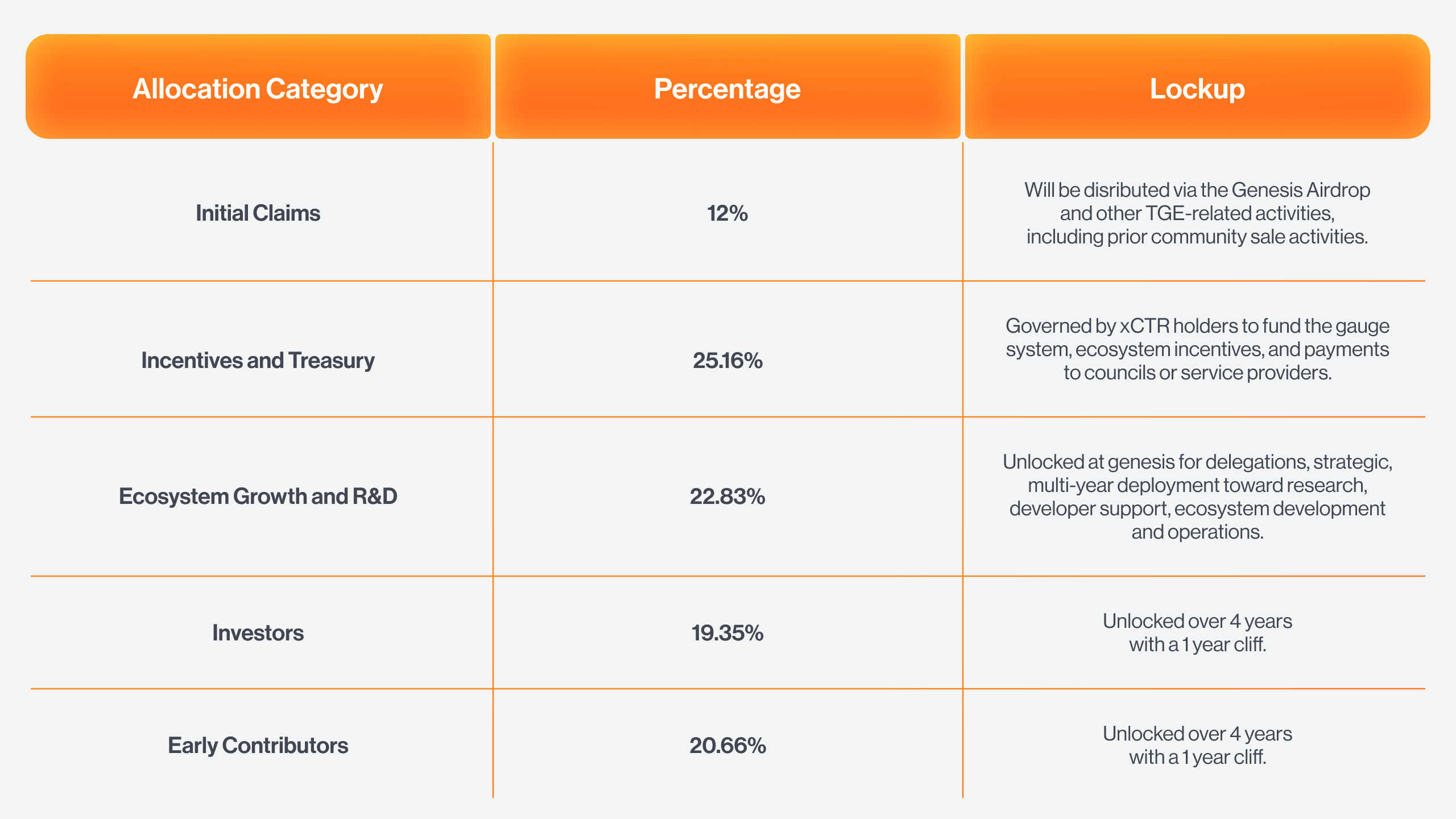
CTR has a fixed supply of 10 billion tokens, with 34.83% unlocked at launch. However, a significant portion of the ecosystem growth allocation is designated for staking, delegation, and long-term network support, and is not expected to enter active circulation at launch. CTR is natively issued on the Citrea Network as an ERC-20 token and is also available on the Base Network in bridged form.
The initial distribution of CTR prioritizes active network users and participants contributing to the Bitcoin economy. As a result, 60% of the supply is allocated to the community and ecosystem, including 12% allocated to the Genesis Airdrop and other TGE-related initiatives.
What’s Next: CTR Launch
The launch of CTR activates the coordination engine that hands control of the Bitcoin economy back to its users.
Stay tuned for the next few weeks. The key timelines, CTR launch details and the genesis airdrop will be announced in the following weeks.
The Bitcoin economy should be owned by the people who use it. Soon, it will be.
Summary
- Citrea is Bitcoin's first ZK Rollup — fully programmable, secured entirely by the Bitcoin Network via a trust-minimized BTC bridge powered by BitVM.
- CTR is the native token with a fixed supply of 10 billion. It has no voting power on its own.
- xCTR is the staked, non-transferable form of CTR. It grants voting power over the Governance Treasury and the network, with a 90-day unstaking window and penalties that reward long-term stakers.
- Dual Treasury cleanly separates responsibilities: Governance controls liquidity incentives and council selection; the Foundation handles R&D, grants, and strategic operations.
- Gauge System (post-launch, subject to governance activation) lets xCTR voters direct liquidity emissions per epoch, earning multiplied rewards on the pools they vote for.
- The key timelines, CTR launch details and the genesis airdrop will be announced in the following weeks.